




- Home
- Application
- Aerospace
OEM & ODM Aerospace Components

Aerospace Component Manufacturing: From Lightweight Design and Precision Machining to Thermal and Structural Integration
Aerospace parts often require both complex geometry and high-precision functional features. Die casting can efficiently form housings, fins, bosses, ribs, and thin-wall structures, while CNC machining is used for bearing bores, locating holes, sealing surfaces, and critical datums.
This near-net-shape plus precision-machining approach helps reduce material waste, machining time, fixture requirements, and total production cost.
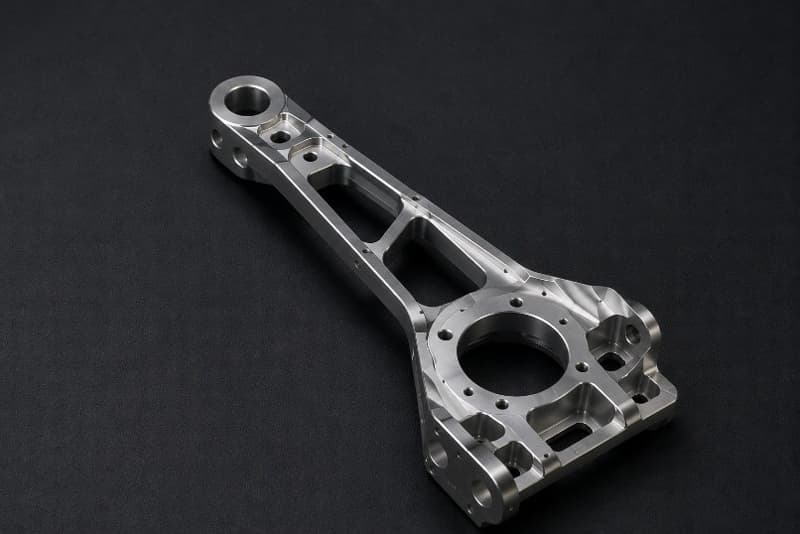
Aluminum Die Casting for Lightweight Structures
Aluminum alloys are widely used for UAV housings, avionics enclosures, thermal structures, and mechanical brackets because of their low weight, thermal conductivity, and mass-production efficiency.
Key engineering risks include shrinkage porosity, gas porosity, cold shuts, and distortion. These problems are strongly affected by wall-thickness variation, gate design, venting, and local heavy sections.
Early DFM review of wall thickness, fillets, gate location, venting, and machining allowance can reduce tooling changes and downstream defects.
Thermal Management and Manufacturability
Thermal housings must balance heat dissipation with manufacturability.
Cooling-fin geometry, base thickness, heat-source contact area, material conductivity, and heat-flow path all affect thermal performance.
Very thin or tall fins may increase surface area but also increase filling and distortion risk. Good thermal design must therefore balance heat transfer, rigidity, and production stability.
Precision CNC Machining for Critical Features
Critical aerospace features such as bearing bores, locating holes, threads, sealing surfaces, and mating datums often require CNC machining.
Flatness, parallelism, perpendicularity, concentricity, and positional accuracy can be more important than a single linear tolerance.
Applying unnecessary tight tolerances across the entire part increases machining time, inspection cost, and scrap without necessarily improving function.
Thin-Wall Design and Distortion Control
Lightweight aerospace parts often use thin walls and ribs, but these features are more sensitive to warpage and residual-stress distortion.
Wall-thickness balance, structural support, machining sequence, fixturing, and material-removal strategy should be considered during the design stage.
Effective lightweight design means balancing weight, stiffness, fatigue performance, and manufacturability.
Engineering Plastics for Avionics
Engineering plastics are suitable for electronic modules, insulating structures, connectors, housings, and internal supports.
Material selection should consider operating temperature, shrinkage, moisture absorption, flammability, chemical exposure, and creep under long-term loading.
Surface Treatment and Final Dimensions
Anodizing, conversion coating, plating, sandblasting, and painting can affect dimensions and fit.
Precision bores, threads, sliding surfaces, and mating areas should clearly define masking requirements and whether final dimensions apply before or after surface treatment.
Production Stability
The key challenge is not producing one successful sample, but maintaining consistent quality throughout mass production.
Material control, tooling condition, cutting-tool wear, fixturing repeatability, dimensional drift, and inspection standards must be controlled from prototype through production.
For engineering and procurement teams, supplier evaluation should include process integration, dimensional capability, inspection capability, and production stability—not only unit price.