






OEM/ODM Manufacturing Solutions for Precision Semiconductor Equipment Components
With the rapid development of AI, High-Performance Computing, and advanced semiconductor manufacturing processes, semiconductor equipment requires increasingly higher standards for the dimensional accuracy, stability, cleanliness, and surface quality of precision mechanical components.
Mechanical parts, jigs, fixtures, equipment housings, vacuum equipment components, and precision metal parts used in semiconductor equipment often cannot be manufactured through a single process. Instead, they typically require the integration of multiple manufacturing technologies, including CNC precision machining, 5-axis machining, aluminum and zinc alloy die casting, precision grinding, anodizing, and other surface finishing processes.
With over 30 years of experience in precision manufacturing and supply chain integration, TRY provides customized OEM/ODM manufacturing services for semiconductor equipment components based on customer drawings, 3D CAD models, samples, and specific product requirements.
What Types of Precision Components Are Commonly Used in Semiconductor Equipment?
Different types of semiconductor manufacturing equipment have different requirements for mechanical components. Common precision components include:
- Precision mechanical components for semiconductor equipment
- Vacuum equipment components
- IC and wafer-related jigs and fixtures
- Precision positioning and mounting components
- Sensor mounting components
- Aluminum equipment housings and structural components
- Thermal management and heat dissipation components
- Precision components for automation equipment
- Custom CNC precision-machined parts
The appropriate manufacturing process should be selected based on factors such as material, dimensions, geometry, tolerances, surface roughness, cleanliness requirements, and operating environment.
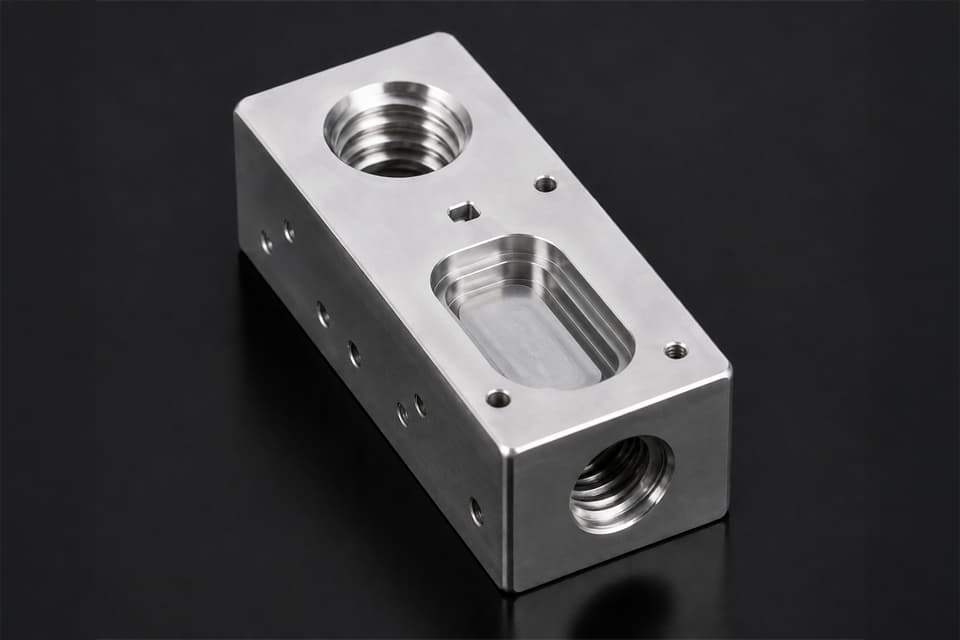
1. CNC Precision Machining: A Key Process for Semiconductor Equipment Components
CNC precision machining is one of the most commonly used manufacturing processes for mechanical components in semiconductor equipment, particularly for metal parts requiring high dimensional accuracy and complex geometries.
Common materials include:
Aluminum / Stainless Steel / Carbon Steel / Copper / Brass. Material selection can also be evaluated according to customer drawings and specific application requirements.
Through CNC turning, CNC milling, and multi-axis machining, various features can be produced, including holes, grooves, threads, positioning surfaces, and complex profiles.
For semiconductor equipment components, dimensional accuracy is only one part of the requirement. Specifications such as flatness, parallelism, perpendicularity, concentricity, true position, and surface roughness may also directly affect assembly accuracy and equipment operating stability.
2. 5-Axis CNC Machining for Complex Geometries and High-Precision Components
When semiconductor equipment components require multi-angle holes, complex surfaces, or machining on multiple faces, 5-axis CNC machining can be an effective manufacturing solution.
Compared with conventional 3-axis machining, 5-axis CNC machining can reduce the number of setups required for certain complex components and help maintain positional relationships between multiple machined surfaces.
It is particularly suitable for:
Complex mechanical components, precision jigs and fixtures, equipment positioning components, multi-face machined parts, and customized high-precision components.
Achievable tolerances depend on the part dimensions, material, geometry, machining features, and measurement methods and should therefore be evaluated on a project-by-project basis.
3. Aluminum and Zinc Alloy Die Casting for Volume Production
For components with higher production volumes and designs suitable for mold-based manufacturing, die casting can be considered.
TRY supports the manufacturing of aluminum and zinc alloy die-cast components, with secondary CNC machining available according to product requirements.
A typical manufacturing process may include: Die Casting → CNC Precision Machining → Surface Finishing → Quality Inspection → Assembly
This manufacturing approach can be applied to equipment housings, structural components, brackets, and other parts requiring both structural performance and efficient volume production.
For mass-production projects, integrating die casting with secondary CNC machining can also reduce material waste and machining time compared with producing certain components entirely from solid stock.
4. Precision Grinding for Critical Dimensions and Mating Surfaces
After CNC machining, certain semiconductor equipment components may require precision grinding to achieve specific requirements for critical dimensions or mating surfaces.
Precision grinding can be used to improve: Dimensional accuracy, flatness, parallelism, and surface quality.
For components used in precision positioning, assembly, or motion mechanisms, grinding requirements can be evaluated according to the customer's engineering drawings and specifications.
5. Anodizing and Surface Finishing
Aluminum alloys are commonly used for precision equipment components. After machining, anodizing or other specified surface finishing processes can be applied according to the operating environment and customer specifications.
Depending on the required specification, anodizing can improve the aluminum surface's corrosion resistance, wear resistance, and overall surface protection.
Semiconductor equipment components may also have specific requirements for surface treatment, cleaning, or cleanliness. Therefore, the appropriate surface finishing process should always be determined according to the customer's drawings, specifications, and actual operating environment rather than applying the same process to every component.
6. From Drawing to Mass Production: OEM Manufacturing Process for Semiconductor Equipment Parts
A typical OEM manufacturing project for semiconductor equipment components may follow the process below:
Customer Drawing / Sample / 3D CAD Model → Design for Manufacturability (DFM) & Manufacturing Feasibility Review → Material and Manufacturing Process Confirmation → CNC Machining / 5-Axis Machining / Die Casting → Precision Grinding & Surface Finishing → Dimensional & Quality Inspection → Assembly (Depending on Project Requirements) → Packaging & Shipment
By integrating multiple manufacturing processes, customers can reduce the communication and supply chain management costs associated with coordinating multiple individual suppliers.
Why Do Semiconductor Equipment Parts Require a Professional Precision Machining Supplier?
Manufacturing semiconductor equipment components involves much more than simply “machining a part to the specified dimensions.”
Every stage—from material selection, machining datums, geometric tolerances, and surface roughness to cleaning, surface finishing, and final quality inspection—can affect the final assembly and operational performance of the equipment.
When selecting a semiconductor equipment parts supplier, customers should consider several important capabilities, including:
CNC precision machining capability, 5-axis machining capability, material processing experience, tolerance control, quality inspection equipment, surface finishing supply chain, mass-production capability, and OEM project management experience.
Semiconductor Equipment Parts OEM Manufacturing in Taiwan
TRY specializes in precision component manufacturing, with manufacturing capabilities including:
CNC Precision Machining | 5-Axis Machining | Aluminum & Zinc Alloy Die Casting | Forging | Plastic Injection Molding | Precision Grinding | Surface Finishing | Assembly
We can evaluate manufacturing processes based on customers' 2D drawings, 3D CAD models, samples, or specific product requirements and provide suitable manufacturing solutions according to material, precision, strength, surface finishing, and volume production requirements.
In addition to semiconductor equipment components, our precision manufacturing capabilities are also applied to components for AI/HPC equipment, UAVs (drones), humanoid robots, automotive and motorcycle applications, and other industrial equipment.
FAQ: Semiconductor Equipment Parts Manufacturing
Q1: What manufacturing processes are commonly used for semiconductor equipment parts?
Common processes include CNC turning, CNC milling, 5-axis machining, precision grinding, and surface finishing. For products requiring higher production volumes, aluminum or zinc alloy die casting combined with secondary CNC machining may also be considered depending on the part design and application requirements.
Q2: What materials are commonly used for semiconductor equipment components?
Depending on the application, commonly used materials include aluminum alloys, stainless steel, carbon steel, copper, brass, and other engineering materials. The appropriate material should be selected based on factors such as strength, weight, corrosion resistance, thermal conductivity, and operating environment.
Q3: Can you manufacture OEM components according to customer drawings?
Yes. TRY can provide OEM/ODM custom manufacturing services based on customer-supplied 2D drawings, 3D CAD models, samples, and specific product requirements. Our team can evaluate the appropriate materials and manufacturing processes according to each project's requirements.
Q4: Can you provide CNC machining, surface finishing, and assembly as an integrated service?
Yes. Depending on project requirements, we can integrate CNC machining, precision grinding, surface finishing, quality inspection, assembly, packaging, and shipment into a complete manufacturing solution.
Q5: Can semiconductor equipment components achieve tolerances of ±0.001 mm?
Achievable precision depends on several factors, including part dimensions, material, geometry, machining method, and measurement method. For selected critical dimensions, the feasibility of achieving micron-level tolerances, including ±0.001 mm, can be evaluated according to the customer's drawings and technical requirements.